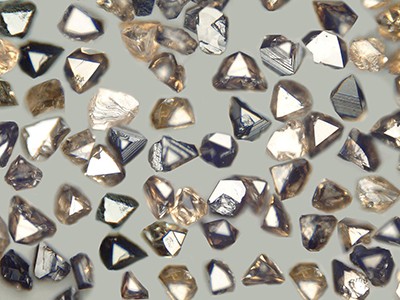
In the realm of superhard materials for modern industry, diamond and cubic boron nitride are widely recognized as the two core pillars. Although their hardness is comparable, their significantly different physical and chemical properties have led to a highly complementary relationship across various applications, making them indispensable key materials in the field of high-end manufacturing.
Diamond is the hardest known natural substance. Synthetic diamond is produced from graphite under high-pressure, high-temperature conditions ranging from 10,000 to 100,000 atmospheres and 1,500 to 2,500 degrees Celsius. It features an intact grain structure, high purity, and a low coefficient of linear expansion. Thanks to its exceptional hardness and wear resistance, it occupies an irreplaceable position in numerous fields. In the photovoltaic and semiconductor processing sectors, diamond cutting wires are the undisputed workhorses. With wire diameters as fine as 50 micrometers and kerf widths of just 60–80 micrometers, they can reduce the cutting thickness of monocrystalline and polycrystalline silicon wafers to as little as 100 micrometers, directly increasing material utilization by more than 20%. Precision cutting of hard and brittle third-generation semiconductor materials, such as sapphire substrates and silicon carbide, is indispensable without the use of diamond. In the oil and gas drilling sector, drill bits equipped with diamond-embedded composite blades can efficiently fracture deep geological formations, significantly improving drilling efficiency for oil and gas extraction. In addition, tools such as diamond grinding wheels and diamond cutting blades are widely used in applications such as stone cutting, optical lens polishing, and precision mold machining. Diamond hydraulic rock saws in construction engineering can replace traditional blasting methods to achieve precise cutting of reinforced concrete and rock strata, significantly improving operational safety in mining and building renovation projects.
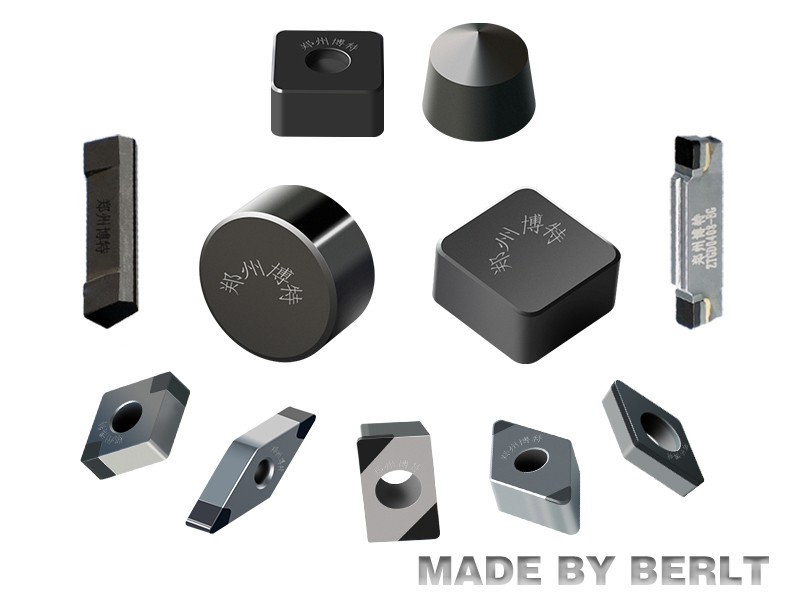
Cubic boron nitride, an emerging all-purpose superhard material, was first synthesized artificially in 1957 using ultra-high-pressure technology. Its hardness ranges from HV3200 to HV4000, and the Vickers hardness of cubic boron nitride with a nanotwin structure can even reach 108 GPa, surpassing that of synthetic diamond. Its most significant advantage is its exceptional chemical inertness toward iron-group metals; it does not react with materials such as steel, iron, cobalt, or nickel at temperatures below 1,150 degrees Celsius, thereby perfectly addressing the challenges associated with diamond tools—namely, the high-temperature chemical reactions and accelerated wear that often occur when machining steel. In the field of machining, polycrystalline cubic boron nitride (PCBN) inserts are the material of choice for machining hardened steel, cold-hardened cast iron, and heat-resistant alloys. Specifically designed for high-speed turning and milling of ferrous metals in the HRC 45–68 hardness range, they produce workpieces with superior surface finish, and tool life is dozens of times longer than that of traditional cemented carbide tools. They are widely used in the mass production of precision parts such as automotive engine blocks and bearings. At the same time, its thermal stability far exceeds that of diamond; it does not oxidize in the atmosphere below 1,300 degrees Celsius, and it undergoes a phase transition only at 1,550 degrees Celsius in a vacuum environment. Combined with its ultra-high thermal conductivity of 1,300 W/mK, it can also serve as a heat spreader for semiconductor packaging and a heat sink material for high-temperature, high-frequency electronic devices. Thanks to its ultra-wide bandgap of 6.4 eV, it demonstrates immense application potential in the fields of short-wavelength light-emitting components and high-temperature-resistant semiconductor devices.
Today, these two superhard materials have been jointly included in China’s classification of strategic emerging industries. As the core hub of the nation’s superhard materials industrial chain, Henan Province is leveraging its local industrial strengths to promote the in-depth application of both materials in fields such as high-end manufacturing, third-generation semiconductors, and aerospace. Driven by these two materials acting as twin engines, Henan is providing a solid material foundation for the upgrading of China’s precision manufacturing sector.